Invoking Fifth Amendment rights can lead to severe consequences, such as inferences of liability in civil cases or termination from employment for refusing to answer questions about corporate crimes.
The Fifth Amendment of the United States Constitution guarantees that no person in a criminal case can be compelled to be a witness against themselves.
An experienced criminal defense attorney at Moses & Rooth can help you determine if pleading the fifth is the right option for you when testifying.
Key Takeaways:
- The Fifth Amendment protects against self-incrimination in criminal cases.
- Criminal defendants can refuse to testify, but once they do, they must answer fully.
- Juries cannot assume guilt if a defendant pleads the Fifth.
- In civil cases, pleading the Fifth may result in adverse inferences.
- Witnesses can plead the Fifth for self-incriminating questions but must testify otherwise.
- Prosecutors may offer immunity or reduced charges in exchange for testimony.
- The Fifth does not protect against physical evidence like DNA, fingerprints, or digital decryption orders.
- Pleading the Fifth can have non-criminal consequences, such as job loss.
- Always consult a criminal defense attorney before deciding to plead the Fifth.
Pleading the Fifth as a Criminal Defendant
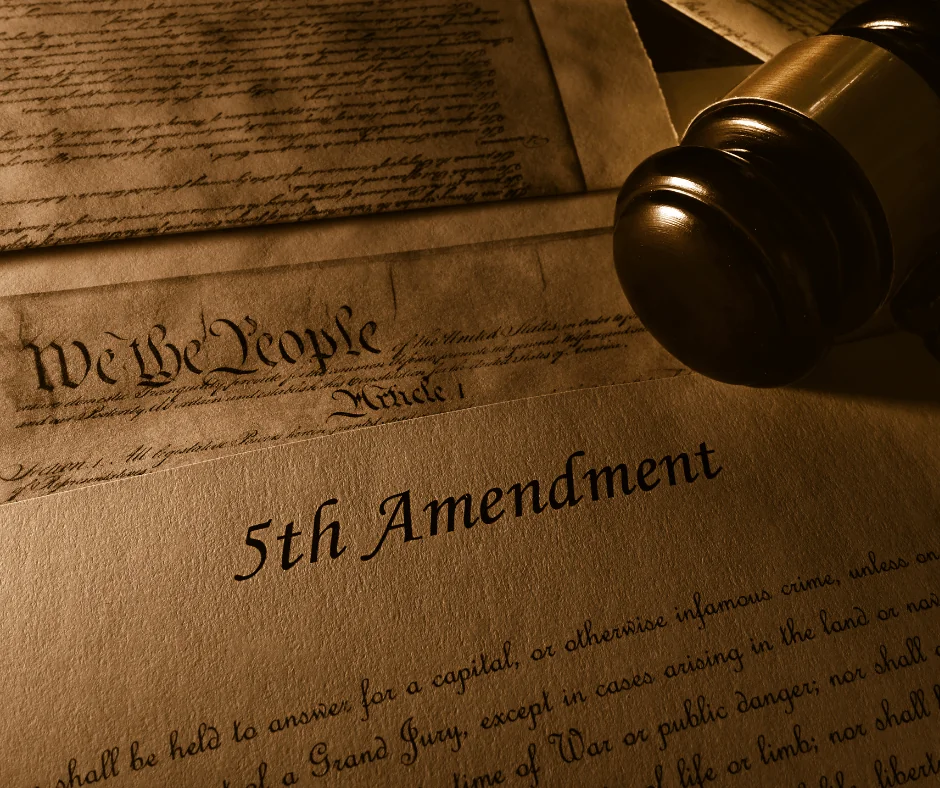
In Malloy v. Hogan, the U.S. Supreme Court ruled a defendant has the right to plead the fifth in State criminal cases, as well as, Federal criminal cases. As a criminal defendant, you can choose not to take the stand in order to protect yourself from self-incrimination, however, once you have chosen to do so you have waived your right to testify.
Criminal defendants cannot choose to answer some questions and not others. It’s an all or none scenario in criminal cases.
In Griffin v. California, the U.S. Supreme Court ruled that a jury may not infer that a defendant is guilty because the defendant pled the fifth and refused to testify. The U.S. Supreme Court later strengthened this ruling in Ohio v. Reiner.
Pleading the Fifth in a Civil Case
You can plead the Fifth Amendment in a civil trial or deposition. Deciding whether to do so requires evaluating risks and benefits. Refusing to testify in a civil matter may lead to adverse consequences for the case.
Pleading the Fifth as a Witness
A witness, like a defendant, may assert their Fifth Amendment right to prevent self-incrimination. A witness may refuse to answer a question if they fear their testimony will incriminate them. The criminal activity that the witness fears does not have to pertain to the case at hand.
If a witness chooses to plead the fifth, unlike criminal defendants, this does not allow them to avoid testifying altogether. Witnesses subpoenaed to testify must testify, but can plead the fifth for questions that they deem are self-incriminating.
Prosecutors may offer witnesses immunity in exchange for their testimony. Witnesses with immunity will not be charged for any incriminating statements made while testifying. When immunity is not on the table there is another option. Prosecutors may offer to reduce the charges if the witness agrees to testify.
When Pleading the Fifth Will Not Protect You
Defendants cannot assert their Fifth Amendment right to protect themselves from self-incrimination against evidence the Court deems to be non-communicative.
A defendant cannot plead the fifth when objecting to the collection of DNA, fingerprint, or encrypted digital evidence. In Commonwealth v. Gelfgatt, the American Civil Liberties Union (ACLU) and the Electronic Frontier Foundation filed an amicus brief in support of a defendant whose right to protect himself from self-incrimination was being threatened by an order to decrypt his computer. However, the Court ruled it was not a violation of the defendant’s rights.
Before testifying as a criminal defendant or witness let the criminal defense lawyers of Moses & Rooth in central Florida advise you on your options of pleading the fifth and protecting yourself against self-incrimination. Our lawyers have a depth of knowledge because we only handle criminal defense cases. If you fear testifying will lead to criminal charges contact us today for information on how to protect yourself.


Learn More About What Happens When You Plead The Fifth
For more information and questions about pleading the fifth, contact the attorneys at Moses and Rooth. Our experienced lawyers can help you navigate your case, determine if pleading the fifth is the right option and if there are any consequences you need to be aware of. Contact us today.
FAQs
What does it mean to “plead the fifth”?
Pleading the fifth means invoking your Fifth Amendment right not to answer questions when your answers could incriminate you. It is a refusal to give self-incriminating testimony, not an admission of guilt, and the prosecution cannot use your silence as proof that you committed a crime.
Which amendment protects you from having to testify against yourself?
The Fifth Amendment. It protects people from being compelled to be a witness against themselves in a criminal case, which is the constitutional basis for the phrase “I plead the fifth.”
Can a defendant be forced to testify at their own trial?
No. A criminal defendant has an absolute right not to take the witness stand at all, and the jury is not supposed to hold that silence against them. This is different from a witness, who can be called but may still refuse to answer specific questions that could incriminate them.
Does the Fifth Amendment protect you from giving physical evidence like fingerprints or DNA?
Generally no. The Fifth Amendment protects against being forced to give testimonial (spoken or communicative) evidence against yourself. It usually does not protect against providing physical evidence such as fingerprints, handwriting samples, or DNA, which courts have treated differently from testimony.
When can you plead the fifth?
You can invoke it when answering truthfully could expose you to criminal liability. It applies to defendants and to witnesses, and it can come up during police questioning, at trial, and in other proceedings. It does not apply simply because an answer would be embarrassing or harmful in a non-criminal way.
Does pleading the fifth make you look guilty?
Legally, no. In a criminal case the prosecution cannot argue that your silence shows guilt, and jurors are instructed not to treat it that way. Choosing whether to testify is a strategic decision that should be made with a defense attorney.
Is pleading the fifth the same as double jeopardy?
No, though both come from the Fifth Amendment. Pleading the fifth is the protection against self-incrimination. Double jeopardy is a separate Fifth Amendment protection that prevents being tried twice for the same offense. They are often confused because they appear in the same amendment.
Should I talk to the police or plead the fifth if I’m being questioned?
If you are a suspect, it is usually wise to clearly state that you want a lawyer and that you are exercising your right to remain silent, then stop talking. Anything you say can be used against you, and a criminal defense attorney can protect your rights before you answer questions.
Related articles:
https://www.mosesandrooth.com/supreme-court-limits-power-miranda-related-silence/